Computational linguist working on semantic cognition, morphological derivation, and LLM hallucination and interpretability, with applied experience in human-feedback (RLHF) data for Korean LLM alignment.
The common thread: speakers encode more than they say, through derivation, register, particles and tone. Nuance that can be measured can be modeled, and what can be modeled can be aligned.
A Large-Scale Empirical Study on Morphological Derivation and the Korean Blue-Green Spectrum · Georg-August-Universität Göttingen · Supervisors: Prof. Dr. Stavros Skopeteas, Prof. Dr. Jacopo Romoli
Does language structure shape perception? Study 1 analyzes a curated corpus of 419 Korean color-term variants; Study 2 is a behavioral experiment across Korea, the US, the UK and Australia. Korean derivation is far more productive than English, and jamo-level similarity predicts semantic similarity better than morpheme-level similarity, partly via consonant strengthening independent of vowel-harmony shift.
419 color-term variants
≈ 21 : 1 KO vs EN unique forms
jamo > morpheme
N = 9,534 trials
Results fit a usage-salience account: frequent, morphologically economical categories are lexically compact and perceptually sharp. The design is correlational; the account is a plausible interpretation, not a demonstrated cause.
Exploring Informativity, Frequency and Morpho-Syntactic Interface of Simplex Verbs and 'root+hata' Light Verb Constructions in Korean · MA seminar, Göttingen
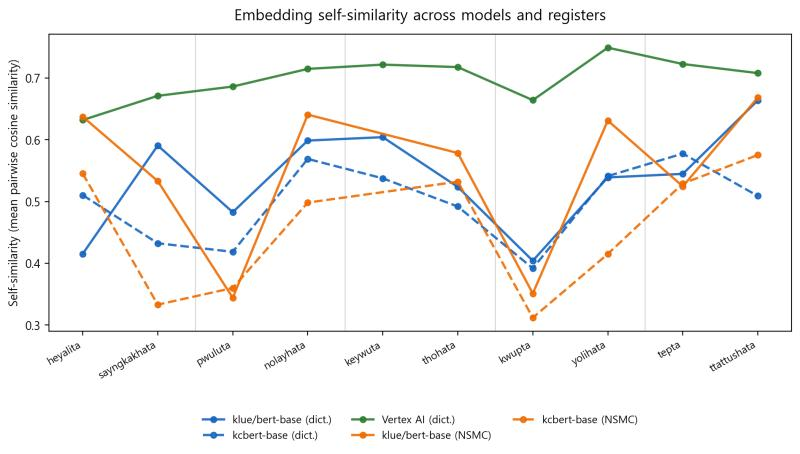
Tests Polinsky and Magyar's (2020) informativity account of head-final lexicons on Korean simplex verbs vs. root+hata constructions, using dictionary sense counts, embedding self-similarity (KLUE-BERT, KcBERT, Vertex AI) and corpus frequency.
38 conditions
predicted asymmetry in 58%
item-driven, not structural
Embedding self-similarity (mean pairwise cosine) for five simplex / root+hata verb pairs, across models and registers.
The Grue Divide: When Cognitive Accuracy Doesn't Predict Affective Alignment
Poster · PANDORA @ EMNLP 2026
Sole author · Proceedings of the First Workshop on Pluralistic AI NLP (PANDORA 2026), pp. 35–68 · DOI 10.18653/2026.pandora-1.2
Claim
Cognitive accuracy does not guarantee affective alignment.
Evidence
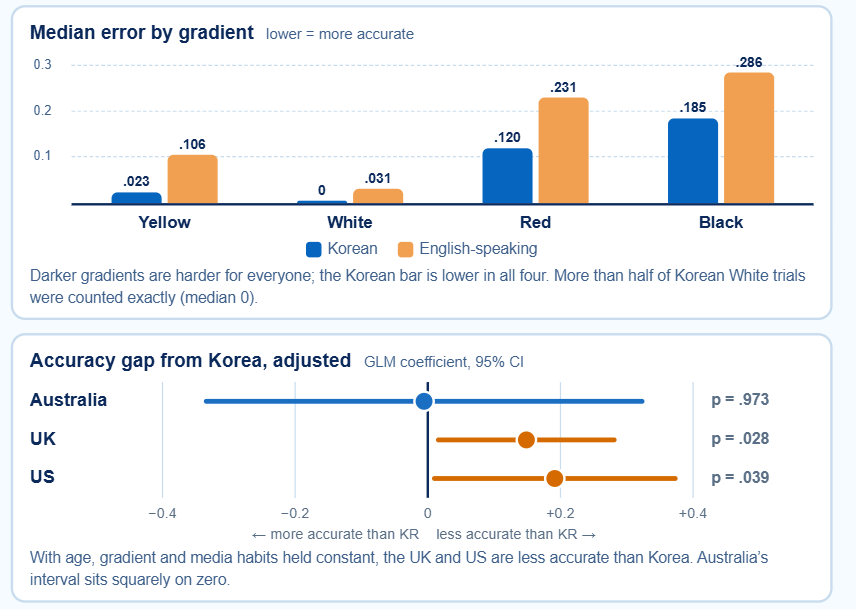
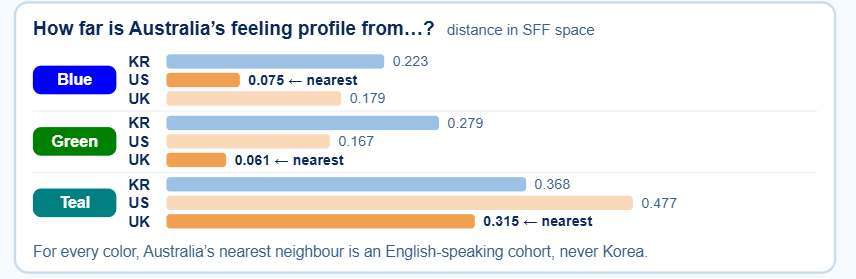
Korean and Australian cohorts are statistically equivalent in error rate (TOST, p = 0.003). Yet in Sentiment–Formality–Friendliness (SFF) space, the Australian cohort clusters with the US and UK, away from Korea.
So what
A model optimized only for categorical accuracy can still miss culturally specific connotation. Alignment should model perceptual and socio-affective signal together.
9,534 trials
~2,200 took part
1,159 analyzed
4 cohorts: KR · US · UK · AU
SFF framework
1 · They see alike: Australia's accuracy is indistinguishable from Korea's once age, gradient and media habits are controlled.2 · They feel apart: in Sentiment–Formality–Friendliness space, Australia's nearest neighbour is always English-speaking, never Korea.
Behind the paper: How to Write a Good Paper, on a year of design changes, reviews and narrowing the scope (Medium, 2026).
Large-scale cognitive data architecture
Experiment platform · 2025
Designed, built and deployed the web experiment behind both studies: a gamified block-counting task on color gradients, then affect-keyword elicitation, with randomized trial order and per-participant stimulus sampling. About 2,200 people took part. The platform was also featured on the DeepL Blog.
Modalpartikeln: Can Sentiments Survive Translation with Emojis?
Term paper · 2024
Decoding Sentiments from German Modal Particles to Korean Using Emojis · The Meaning of Gestures (and more), Prof. Dr. Jacopo Romoli · DOI 10.5281/zenodo.24326143
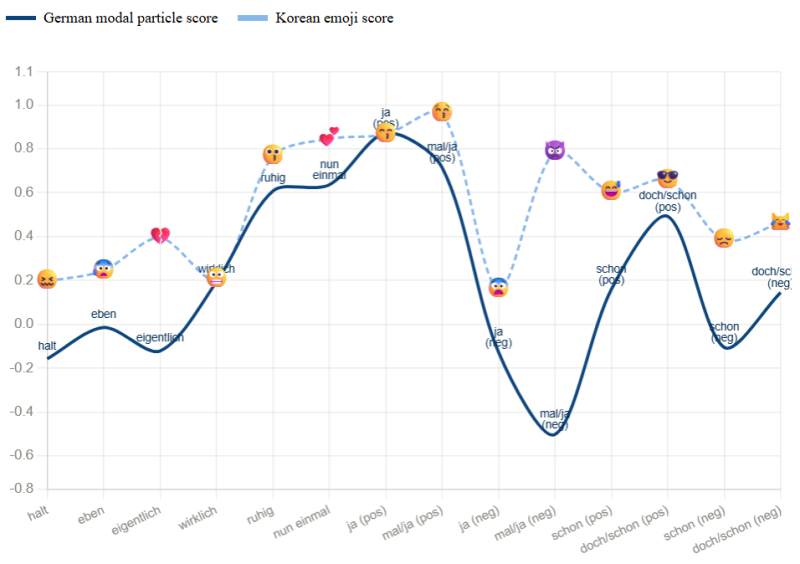
Sehen wir and Sehen wir mal both come out as "Let's see", but the particle mal turns a businesslike decision into a relaxed suggestion. Two surveys measured this: German speakers rated the sentiment of modal particles, and Korean speakers rated expressive emojis. The two sets of scores matched at about 80%, with positive sentiment aligning almost exactly, suggesting emojis can carry tone that translation flattens.
Sentiment of German modal particles (German raters) against their matched emojis (Korean raters).
Sentiment Translator v2, a concept demo on a phone: modal particles in Thai, German and Japanese. Its map is an early form of the SFF (Sentiment-Formality-Friendliness) framework, plotting positive–negative sentiment, friendliness and formality against a shared scoring rubric. Watch with sound on YouTube →Sibling project: Sentiment Interpreter, live interpreting that keeps the feeling
The same SFF rubric, used to guide a live interpreter instead of a scorer. Speak or type in one language, and hear or read it in another: the interpreter judges the original's sentiment, formality and friendliness and matches them in its words and its voice. A meeting mode puts live subtitles in a floating window over slides or a video call. Built on the Gemini Live API.
Sentiment Interpreter, a demo on a phone: typed English spoken back in warm Korean, German doch mal kept casual, and live meeting subtitles. Watch with sound on YouTube →
Human annotation for RLHF in DeepL's Language Data Team: preference ranking of Korean candidates, minimal edits that isolate error signals, and full rewrites as gold-standard data.
KO–EN cross-lingual work: syntactic classification, source-text correction and translation-quality judgments, plus linguistic rationales and decision criteria for ambiguity that fed into the core NLP research team's guidelines.
Proposed a pragmatic framework (Sentiment, Formality, Friendliness) internally for modeling social distance in controlled generation, with honorific and politeness hierarchies framed as data guidelines for tone-control models; the unadopted proposal later became an independent, sole-authored PANDORA paper.
Tested the pre-release formality feature in the v3 API beta with a few domain example sentences and reported register issues through DeepL's public developer community; also built a working prototype of the "Nudge Editor" concept.
Nov 27–28, 2026 · Invited speaker · my session Fri, Nov 27, 9:20–9:50 AM (GMT+1) APAC AI for Science DevFest 2026, Google Researcher Groups (GDG AI for Science). Lessons from an MA thesis and an ARR submission: why empirical linguistics matters for evaluating AI, and using AI tools and cloud resources to get past technical bottlenecks. Talk links →
A Python script that searches several zones for free Spot TPUs, provisions one and sets up the environment, so TRC researchers stop refreshing the console.
How the narrated Sentiment Translator demo was made without a designer or video editor: Playwright recording at phone size, HTML cards, text-to-speech narration and ffmpeg, all scripted with Claude Code. A recipe for showing off any research prototype.
The same recipe, packaged as a skill for Claude Code, Antigravity and Gemini CLI. The agent suggests what to show and drafts a storyboard for you to approve. It then records the app, adds narration, cards and generated music, and renders a 1080p video, with vertical and square cuts for social media if you want them. If Blender is installed, it can also render a 3D stage and title clips, free and offline. The video above is a square demo of the skill, made with the skill. An early release.
A small kit for building a personal research wiki with any AI assistant: an Obsidian note template and copy-paste prompts. The agent fills in the facts; the questions and opinions stay yours. Papers to read are kept like a to-do list, so the wiki links only what you have actually read and grows into a graph of your reading.
A plush-toy Christmas tree made of about 7,000 letters, turning slowly in 3D. A little chick face on the bottom tier turns with the tree, blinks and chirps. It runs live in a window under a night or day sky, and also comes as animated SVGs.
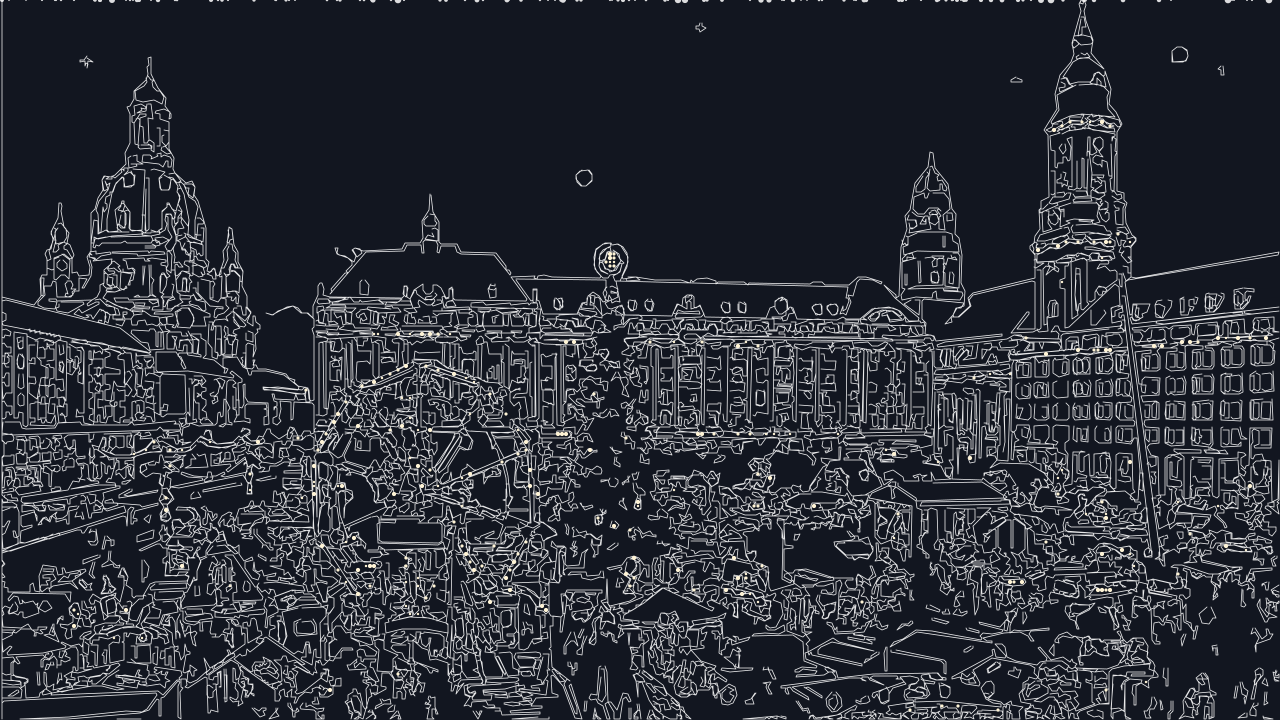
Bring the festive market stroll straight to your cozy room. A fan-made Claude Code mod that puts a twinkling Christmas market behind the conversation in the desktop app, redrawn in braille dots from a Gemini-generated picture. It comes with two small scripts that turn any picture into a dot or line-art backdrop.